
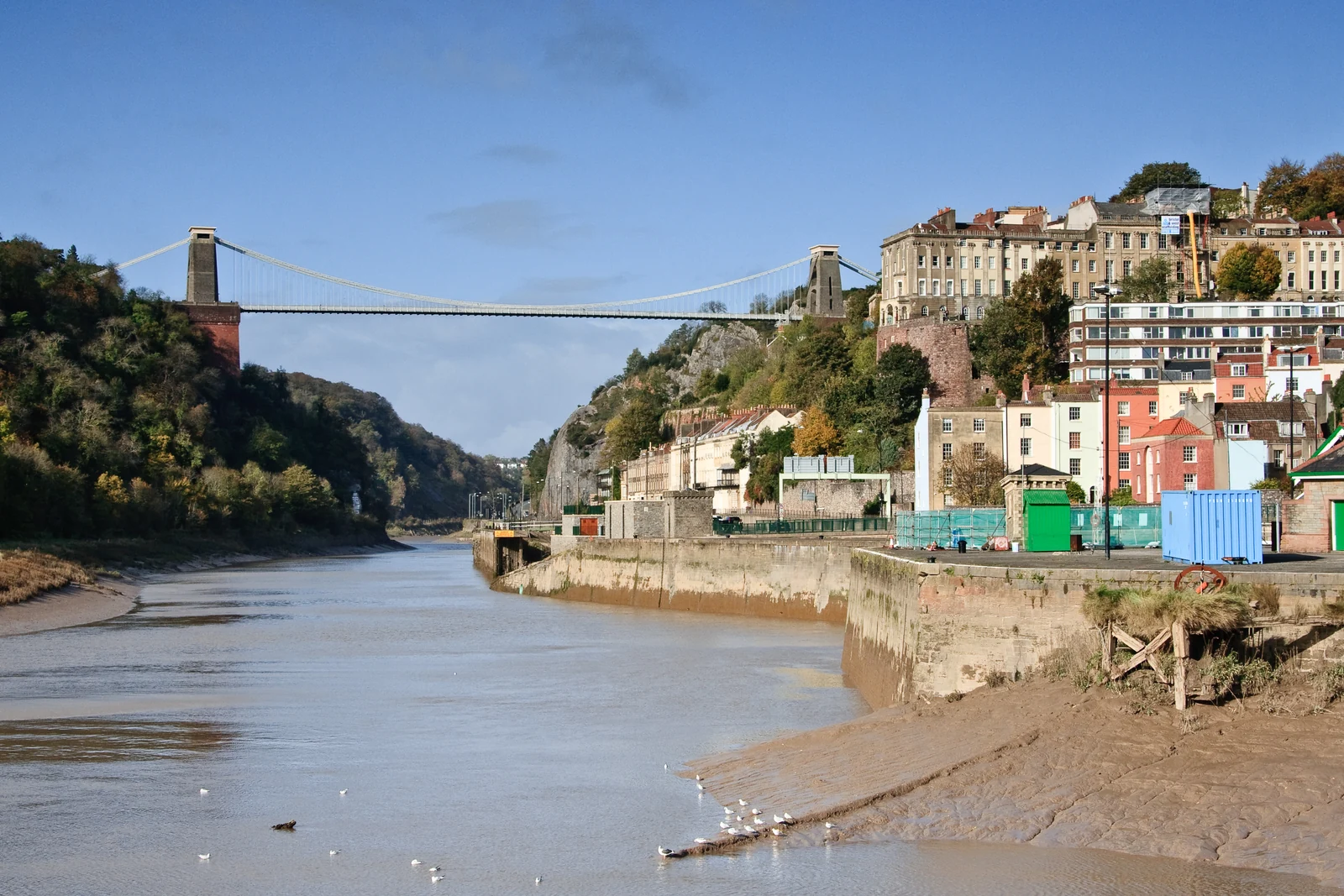
For a first visit: reach the bridge from Clifton Village, take time to view it from nearby on the Bristol side, then cross to the museum on the Leigh Woods side. Allow around an hour to an hour and a half on site, plus travel from the centre. Crossing on foot and the museum are free.
Bristol’s most recognisable landscape
In Clifton, you discover a different landscape from the harbour, with hills and the Avon Gorge. The bridge does not sit in the historic centre: it links Clifton with Leigh Woods above a dramatic break in the landscape. This change of scale makes the walk so pleasant after streets and quays.
Approaching on foot, you first see the whole bridge, then its towers, chains and hangers, before appreciating the gorge’s depth. It remains a working road bridge: pedestrians use pavements and vehicles use the carriageway. For photographs, the surroundings offer more distance than the middle of the deck.
The project bears Brunel’s name, chosen when very young to design it. Construction nevertheless spanned several decades: the bridge opened only on 8 December 1864, after his death. The small museum tells this story and complements a visit to SS Great Britain, another major Bristol work associated with the engineer.
A simple walk around the bridge
Start on the Clifton side
From Clifton Village’s streets, head to Sion Hill and the bridge surroundings. Before crossing, spend a few minutes on the Bristol side looking at towers, deck and gorge without descending into the valley.
The Observatory area offers another perspective from above. Any ticket for the observatory or its attractions is separate from the bridge walk. For a first visit, I suggest starting outdoors: these spaces already let you observe the bridge and gorge.
Crossing on foot
Use the pavement open to pedestrians and reach the Leigh Woods side. The crossing itself is quick; wanting to pause extends your time here. Wind can be noticeable over the gorge. In bad weather, a short crossing followed by the museum is more pleasant than a long wait outside.
Cyclists normally use the road and designated lanes at the barriers. To use the pedestrian pavement, dismount. The operator announces any pavement closures for maintenance. If only one side remains accessible, you may need to adapt your route.
Finish at the museum on the Leigh Woods side
The museum is on the bank opposite Clifton Village. Admission is free and usual hours are 10am to 5pm daily. A film, objects and documents explain bridge construction and maintenance. It is easy to make a short stop after crossing.
Allow around twenty to forty minutes according to your interest. With children, bridge-building exhibits offer a more concrete activity than reading panels alone. Guided tours of the hidden vaults beneath a tower, when offered, are a separate experience requiring booking and their own conditions.
Prices, opening hours and booking
| Access | Price and arrangements |
|---|---|
| Crossing on foot | Free; bridge normally accessible 24 hours a day, subject to work and occasional restrictions. |
| Bridge museum | Free; usually 10am to 5pm daily. |
| Crossing in a motor vehicle | Toll of £1.00 ≈ €1.19 per crossing, contactless payment. |
| Tours and vaults | Depending on the programme, some tours are paid and require separate booking. |
You can therefore do the essential walk without a ticket. A guided tour mainly makes sense if bridge construction interests you or you want to discover areas closed to ordinary passage. Tours offered by the operator explain the programme and conditions.
How do you get here from Bristol city centre?
Walking from the centre takes approximately forty-five minutes, longer with breaks. Clifton is uphill: the climb matters as much as distance. The most interesting sightseeing-day route passes Park Street, Bristol Museum and Clifton’s streets. It is described in our Clifton and viewpoints day.
The number 8 bus links Temple Meads and Clifton Village. It reduces the climb, leaving the final walk to the bridge. To plan outbound and return travel, find timetables and stops in the Bristol transport guide. From the Clifton Village stop, several streets remain to walk before the bridge.
By car, the museum has no dedicated car park. Clifton Village spaces have their own rules and charges; for a stay mainly focused on the centre, walking or taking a bus is simpler than moving the car solely for this visit.
When should you enjoy the bridge?
Late afternoon combines a neighbourhood walk with lower light over the gorge. In winter, darkness comes early: arrive in time for the museum if you want to enter. The illuminated bridge brings another atmosphere at night, but a first daylight visit helps you understand the landscape.
I recommend giving this part of the city half a day rather than a return trip solely for a photograph. A Clifton Village break, the museum and different viewpoints offer reasons to extend the walk. With just one Bristol day, however, a bridge outing requires cutting back the harbour museums.
Slopes, pushchairs and museum access
The museum is described as accessible, but the journey from the centre involves a real climb. Approaches to viewpoints around the Observatory differ in gradient and surface. With a pushchair or difficulty walking, a bus to Clifton Village and direct route to the bridge are more comfortable than an improvised loop on gorge paths.
On the bridge, use pavements and leave room for other visitors. Road traffic stays close; take photo breaks without stepping into the carriageway. The official access guide and planned closures give any changes for the day.
Extending the walk in Clifton
Returning towards Bristol, find Clifton Village’s small streets. It is a good end to the route for lunch or a break before returning. Art lovers can place Bristol Museum on the outward journey; those who prefer walking can spend longer in the neighbourhood and near the gorge.
The Bristol map brings together the bridge, museum and nearby stops. To find somewhere for a break or several nights, continue with our Clifton guide: it includes the walk and advice for your stay.